Problem description
Blade cuts in POST always require an S2M mesh which will most probably not exist for a Q3D case. There are two options to solve this problem.
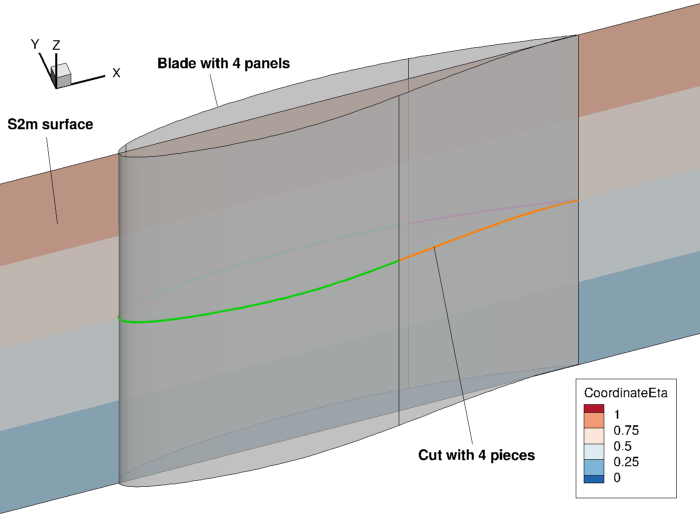
Q3D case with blade, S2M surface and resulting cut.
Generate S2M by POST
If you have a translational configuration, the easiest would be to let POST generate an S2M mesh for Q3D cases with the task generateQ3DS2M. The command line could then look like this:
POST \
--input TRACE.cgns -rbc \
--calcMolecularViscosity \
--shearStressWall \
--generateQ3DS2M \
--intersectLine -q3d \
--interpolate1d -order 1 \
--deleteBlock -keep -dim 1 \
--interpolateCellCenteredToVertexData \
--output bladeCuts.plt
This would generate an auxiliary S2M mesh using the extremal xz- or xr-coordinates of your configuration. It must be run using 1 process only. The -q3d sub-option of intersectLine generates the cut at half the height of the configuration. Make sure to use -order 1 for interpolation.
Generate S2M using Tecplot
If the above fails for any reason or you have a rotational configuration, you can still create your S2M mesh using Tecplot. Create a rectangular zone spanning the complete geometry. It suffices to just use 2 vertices per direction. Set CoordinateXi and CoordinateEta from 0 to 1. A file s2m.dat could look like this:
TITLE = "Translation of CGNS file TRACE_2D.cgns"
VARIABLES = "CoordinateX"
"CoordinateZ"
"CoordinateXi"
"CoordinateEta"
ZONE T="Rectangular zone"
I=2, J=2, K=1, ZONETYPE=Ordered
DATAPACKING=POINT
-99 0 0 0
101 0 1 0
-99 0.2 0 1
101 0.2 1 1
You can then run POST using the command line:
POST \
--input TRACE.cgns -rbc \
--calcMolecularViscosity \
--shearStressWall \
--readS2m -ls2 s2m.dat \
--intersectLine -q3d \
--interpolate1d -order 1 \
--deleteBlock -keep -dim 1 \
--interpolateCellCenteredToVertexData \
--output bladeCuts.plt
Using a cut definition file
If you want to merge cuts that belong to blade with multiple panels, you can use a cut definition file to tell POST which panels belong together. A cutfile.dat could look like this:
TITLE = "Input cut positions for intersection"
VARIABLES = "CoordinateEta"
ZONE T = "Cutting Definition"
i=1, j=1, k=1, ZONETYPE=Ordered
DATAPACKING = POINT
AUXDATA PanelFamilies = "lower_surface,upper_surface"
AUXDATA IntersectionFamily = "blade"
0.50
The two panel families will be joined in one cut called blade.
Run POST using the following command line:
POST \
--input TRACE.cgns -rbc \
--calcMolecularViscosity \
--shearStressWall \
--readS2m -ls2 s2m.dat \
--intersectLine -cf cutfile.dat \
--interpolate1d -order 1 \
--mergeAnalysisLines \
--deleteBlock -keep -dim 1 \
--deleteBlock -famtype S1BladeCutPieces \
--interpolateCellCenteredToVertexData \
--output bladeCuts.plt
The last deleteBlock command will delete the single pieces of the blade cut.
- Warning
- Use only one process to execute this command line. (For a speed up see S1 Blade Cuts)
Involved tasks